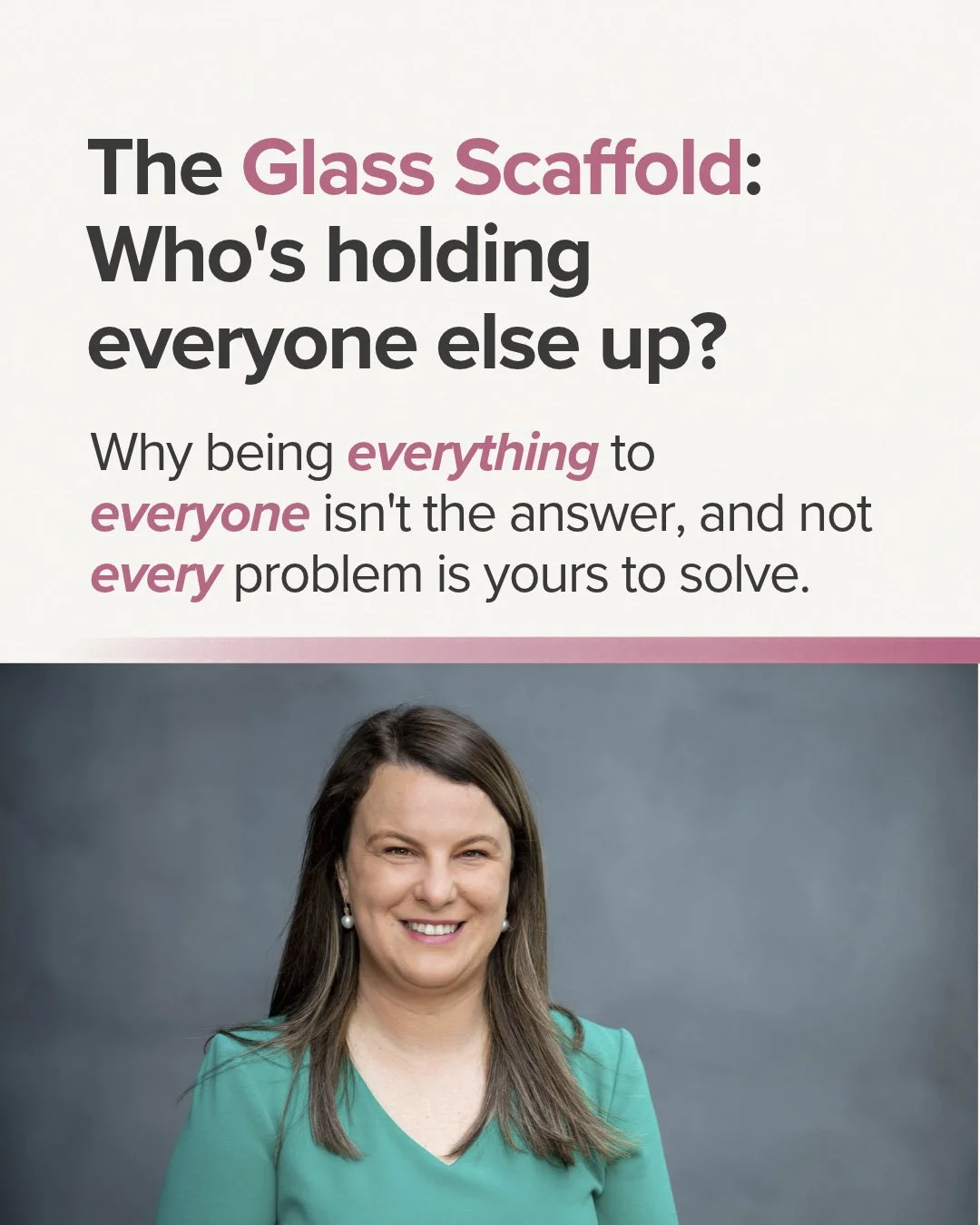
Written by Sarah Queenan, Managing Director – Humanify HR
It has taken me a long time to find a way to put this experience into words. Partly because it's personal, but also because nobody really likes a woman who complains. Especially in Australia, in our culture we are just expected to harden up and get on with it. Never complain, never explain. Or don’t even try to be ‘royal’ about it, just don’t complain and get on with it – women reading this will understand.
But as you can see, I’m sharing my experience because in my work with senior leaders, I see this pattern come up time and time again, so I hope by putting this out into the world it can help others recognise the early signs.
Look everyone knows about the glass ceiling, and more recently the glass cliff and how these can both play out to wreak havoc on women and their careers. But I think there's another phenomenon that deserves our attention. One that can occur before either of these, or alongside them. One that is perhaps more prevalent than the glass ceiling and glass cliff combined, because it is a slow burner that can occur without you even realising it is happening at the time.
I’m calling it the Glass Scaffold
Here we go, I’m joining the club of those people on LinkedIn who make up fancy names for things. Stay with me here. I’m not one of those people, I can assure you.
What is the Glass Scaffold?
The Glass Scaffold is a phenomenon where capable, often high-achieving women find themselves holding up everyone around them, from their teams and leaders to entire organisations.
Think about the purpose of scaffolding. It's the structure that provides stability, holds everything together and enables others to reach greater heights. Yet the scaffold itself is rarely noticed or recognised for what it contributes to the overall project. However, if you take the scaffold away - well you get the picture, everything falls over. Exactly what happens when women who have become the human equivalent of the Glass Scaffold in our workplaces decide they’ve had enough and walk away.
Just like that trusty scaffold on a construction site, that we walk past often without giving a second thought to, women can spend much of their careers supporting the success of others, often at the expense of themselves. Driven by societal expectations that women should be dependable, supportive and responsible for others, this invisible burden can become so normalised that women (and men too!) don't even recognise it happening. And that is a problem we must solve. If we really care about gender equality and progress, well I would suggest the Glass Scaffold is worth taking seriously.
The Glass Scaffold can exist before, during or after the glass ceiling or glass cliff. And just because you're capable of holding everything together doesn't mean you should have to. But what I’ve seen and experienced first-hand myself, is that many women end up holding up much more than what we should expect them to.
I was once the human Glass Scaffold
I know this phenomenon of the Glass Scaffold well, because I spent much of my career being that trusty scaffold. At 27, I had already reached a senior leadership position that many people spend their entire careers working towards. By my early 30s, despite being incredibly successful on paper, I had burnt out.
I had spent years taking responsibility for everyone and everything around me. Like many of you reading this article, I wanted to make a difference and supporting others was something, and still, something to this day, that I genuinely enjoy doing.
But you see working in male-dominated environments, with an Australian ‘toughen up’ overlay as the cherry on top, early in my career when I was the human Glass Scaffold, I was a young woman in senior leadership, undoubtedly holding up a lot of people around me. At that time, showing any sign of weakness was never an option. I was well and truly the human Glass Scaffold; I had to hold it all up and prove that I had what it took to carry the load to the others around me who didn’t want to carry their own weight. It got to a point where I simply couldn’t carry the weight of everything and everyone else anymore. The version of me that had become the human Glass Scaffold eventually malfunctioned under the weight of it all.
I don’t recommend this experience to anyone else. It was above all, a pretty rotten time. This is why I’m writing about it, because I have a sneaking suspicion, I’m not the only one that has experienced this or may currently be going through it right now. It is not a pretty thing. It causes harm. This is why we need to better understand why so many women become a Glass Scaffold, so we can prevent the harm it causes.
Just because you can hold up the weight of others, doesn’t mean you should
Angela Duckworth's research on grit resonated strongly with me during that period of my career. Her work explores the importance of passion and perseverance in achieving long-term goals. But based on my own experience and working with senior leaders, we have confused resilience and grit with an expectation that capable people should simply keep taking on more.
Just because you're capable of holding everything together, does that mean you should?
Short answer: No.
However, it is easier said than done when you have become a human version of the Glass Scaffold. Firstly, you have to realise that it has happened to you. Secondly, you then need to draw on the strength you often don’t have to get yourself out of that situation at the time, as much of your energy has been diverted to holding others up - you might not even know whereabouts to begin when it comes to lifting yourself back up.
Supporting others should never come at a cost to yourself
In late 2019, I spent a week with Professor Lynda Gratton at London Business School. Her research, particularly The 100-Year Life, has stayed with me.
One of the central ideas in her work is that a successful life isn't simply measured by professional achievement or financial success. Our relationships, health and wellbeing are equally important assets that we need to build and maintain throughout our lives.
When we become a human Glass Scaffold, we can mistakenly think at the time that we are giving and supporting others with the objective of investing in these relationships that are so valuable to our relationships and connections. But there is an important difference between building meaningful relationships and becoming personally responsible for everyone else's success and wellbeing. There is a difference when people are taking from you and not making any deposits back.
I have reflected on this deeply. As an eldest daughter, without doubt much of my identity was shaped by the expectation to be responsible, dependable and look after others. And how much of that I carried into my professional life, well I would say it was quite a bit. All of this makes us more at risk to becoming the next human Glass Scaffold in our organisations.
Society expects women to carry it all with a smile on our faces
I also began to recognise how much of this behaviour is influenced by societal expectations of women. From a young age, many women are encouraged to be caregivers, anticipate the needs of others, maintain relationships and put other people first. We are expected to do it all, often whilst maintaining a smile on our faces.
These are qualities that should be celebrated, and are what make many women incredible leaders that are invaluable to the people that work for them and their organisations. However, these expectations society has can also leave women particularly vulnerable to becoming the human scaffold, sometimes without even recognising it is even happening.
And organisations can reinforce this. When someone is capable, hardworking and prepared to take responsibility, it becomes very easy to keep relying on them. Over time, we can begin taking their contributions for granted, particularly when they make everything look so effortless. They do literally become the human scaffold, that nobody gives much thought to. We walk past them. And eventually, because they are only human, they do fall over.
There's also something confronting about looking back at the people I exhausted myself supporting earlier in my career. Many probably wouldn't give me a second thought today, let alone consider what their reliance on me cost me personally. Even more of a reason for us not to become the Glass Scaffold, because ultimately there are no winners.
Preventing the harm caused by the Glass Scaffold
Now, approaching my 40s and running my own business, I have a very different relationship with work and success.
One of the most rewarding aspects of the work I now do with senior leaders is helping them recognise these patterns in their own leadership. Having experienced them myself, I understand just how difficult it can be to distinguish between being a good, supportive leader and taking responsibility for things that aren't yours to carry.
Through coaching, I help leaders work through these challenges in real time. Sometimes that means recognising when they need to step back, allow others to take responsibility and stop trying to solve every problem around them.
Interestingly, this doesn't just make them stronger leaders. It also creates opportunities for the people around them to develop, take ownership and become more capable themselves. Sometimes the greatest support we can give someone is to stop doing things for them that they need to learn to do themselves.
The Glass Scaffold isn't about blaming men or women. It's about recognising a pattern that can develop through the expectations we place on ourselves and others.
We need to become more conscious of when we are relying too heavily on the women around us, particularly those who are so capable that we rarely stop to consider how much they are carrying. Are we genuinely supporting their success and development, or are we benefiting from them that comes at a cost?
And for those who recognise themselves as the human scaffold, I encourage you to consider whether everything you're holding up is yours to carry.
HOT TIP: It probably, and most likely isn’t, so figure out how you can drop it.
It has taken me a long time to find the words to describe this experience. My hope is that sharing it might help someone else recognise it sooner, before they find themselves exhausted from carrying responsibilities that were never theirs in the first place.
The challenge here is about recognising what you can finally put down. Once you do this, you can create space for the weight of the things that were meant for you to carry, and this is where you can really reach your full potential and take full flight – without the weight of everything else holding you back.
More information
At Humanify HR Consulting, our leadership and executive coaching programs support leaders to better understand their behaviours, build self-awareness and develop more effective and sustainable approaches to leadership.
If this article resonates with you, I welcome your thoughts on the Glass Scaffold. You can contact us at hello@humanifyhr.com.au.
Disclaimer: The material contained in this article is provided as general information only. It is not, nor is intended to be professional or legal advice. If you wish to take any action based on the content of this article, we recommend that you seek professional advice that considers your specific context, needs and requirements.