When enterprise bargaining becomes a power struggle: Are we losing sight of what really matters?
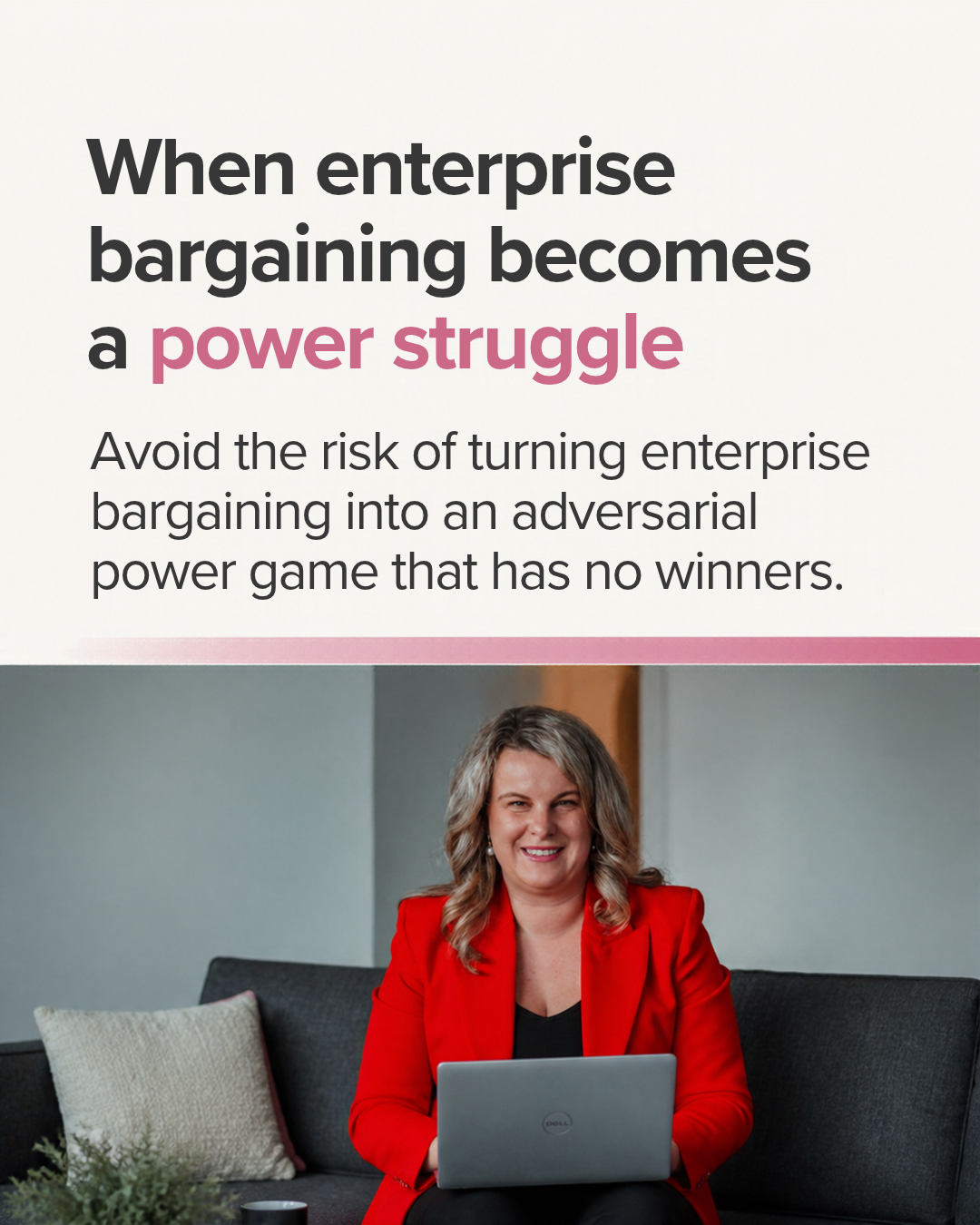
Written by Sarah Queenan, Managing Director – Humanify HR Consulting
Enterprise bargaining is intended to provide employers and employees with an opportunity to negotiate employment terms and conditions. However, when negotiations become difficult, it can sometimes feel as though the process is less about reaching agreement and more about which party holds the greatest power at the bargaining table.
One of the topics we explore in our Enterprise Bargaining Representative Workshops at Humanify HR is how to negotiate with someone who has more power than you, or at least someone you perceive to have more power. Whilst this is particularly relevant for Employee Bargaining Representatives (EBRs), referred to as Individual Bargaining Representatives (IBRs) in the Australian Public Service (APS), it is equally relevant for employers negotiating with experienced union officials or other bargaining representatives.
Interestingly, power in enterprise bargaining isn't always held by the party you might expect, and the way it is exercised can have a significant influence on whether negotiations progress or become increasingly adversarial. This is where enterprise bargaining comes down to not just understanding the technical aspects of industrial relations, but having a deep understanding of human behaviour and how psychology comes into play at the bargaining table.
Who really holds the power at the bargaining table?
It is easy to assume that employers hold the greatest power in enterprise bargaining. After all, they generally control organisational resources, have access to financial information and are often represented by experienced executives, HR practitioners and legal advisers. However, unions and employee bargaining representatives can also exercise considerable influence through their knowledge of employment conditions, negotiating experience and ability to represent the collective interests of employees.
What makes enterprise bargaining particularly interesting is that power can shift throughout negotiations, depending on the issues being discussed, the strength of employee support and the alternatives available to each party if agreement cannot be reached. For employers, particularly those negotiating with highly experienced union officials, the balance of power may be quite different from what they might be used to dealing with. For example, in Australia right now, under the Federal Labor Government, union officials in enterprise bargaining hold much more power than they did a decade ago under the Liberal Government, who unsurprisingly had an anti-union agenda.
When negotiating positions become entrenched
One of the challenges that can arise during enterprise bargaining is when parties become so focused on defending their respective positions that they lose sight of the interests driving them. Whilst employers may be concerned about financial sustainability and operational requirements, employees may be focused on protecting existing entitlements, improving remuneration or securing greater flexibility in their working arrangements.
The difficulty arises when negotiations become focused solely on whether a party will accept or reject a particular claim, rather than exploring why the claim is being made and whether there are alternative ways to address the underlying concern.
When this occurs, the risk of bargaining stalling is much greater. We encourage our clients to helicopter beyond the bargaining table with the goal of trying to identify the interests that sit beneath the claims or positions that seem to be going nowhere. This is where skilled negotiators deliver value in spades, as by finding the interest that sits beneath the claim, this puts all parties in a position to be able to draw breath and gain a better understanding of the emotions that often are sitting unaddressed beneath the entrenched position. The challenge is coming across negotiators who are skilled enough to be able to achieve this, as this can be rare, as evidenced by the many rounds of enterprise bargaining that end up becoming entrenched or stalling.
This is not to suggest that parties should abandon their bargaining positions or make concessions simply to progress negotiations. However, there is a difference between negotiating firmly and allowing the process to become a contest about who is prepared to hold out the longest.
Negotiating with someone more powerful than you
A question we often explore with participants in our workshops is how comfortable they feel negotiating with someone they perceive to have more power. This can be particularly challenging where representatives have different levels of negotiating experience, organisational authority or access to information.
Interestingly, the perception that another party holds more power can sometimes have as much influence as the actual authority they possess. Representatives may feel pressured to respond immediately to proposals, reluctant to challenge information being presented or uncomfortable asking questions for fear of appearing inexperienced or even at worst, reprisal action being taken against them.
Our advice is to focus on what you can control. Prepare thoroughly, understand your bargaining position, ask good questions and don't be afraid to seek additional information or time to consider a proposal. For those who hold greater authority or negotiating experience, it is equally important to be conscious of how your approach may be experienced by those sitting opposite you. It may just be that you think you hold the power, but your arrogance in this belief may ultimately be what causes you to come unstuck.
Know when to hold your position, and when to reconsider it
Two negotiation concepts we explore in our workshops are BATNA (Best Alternative to a Negotiated Agreement) and WATNA (Worst Alternative to a Negotiated Agreement). These encourage bargaining representatives to consider the best and worst realistic alternatives available if negotiations do not result in agreement.
Understanding these alternatives becomes particularly important when negotiations appear to have reached an impasse. For employers, this might involve considering the consequences of prolonged bargaining, workforce dissatisfaction or potential industrial action. For employee representatives, it might involve considering the implications of delayed improvements to pay and conditions, or the continuation of existing employment arrangements.
Taking the time to understand these alternatives can help representatives assess proposals more objectively and consider whether their current negotiating strategy remains the most effective approach. It can act as a powerful signal, that indicates when it might be time to walk away from a particular position or claim, as the cost associated with progressing it may mean that you miss out expanding the pie available in other areas of the negotiation.
When bargaining becomes about winning rather than reaching agreement
Enterprise bargaining will inevitably involve disagreements, and there will be circumstances where parties are unable to reconcile their respective positions. However, when negotiations become increasingly adversarial, it is worth considering whether the difficulties are primarily about the substance of the claims being negotiated, or whether the relationships and behaviours at the bargaining table have become part of the problem. This is where the psychology of bargaining really matters, and negotiators ability to see when it might be becoming a risk really can make or break the negotiation.
Whilst the Fair Work Act 2009 (Cth) establishes good faith bargaining obligations, it does not require bargaining representatives to make concessions or ultimately reach agreement. Parties are entitled to advocate strongly for their interests, but should remain conscious of how their conduct and negotiating approach may influence the ability of others to participate meaningfully in the process.
Ultimately, enterprise bargaining is not simply a technical exercise in negotiating clauses, salaries and employment conditions in accordance with the Fair Work Act 2009 (Cth). It is also a human process, involving people with different interests, experiences and expectations, who will often need to continue working together long after negotiations have concluded.
Regardless of which side of the bargaining table you sit on, having power and knowing how to use it effectively are two very different things.
More information
At Humanify HR Consulting, we work with employers and employee bargaining representatives across Australia to build enterprise bargaining capability and support effective workplace negotiations.
Our Enterprise Bargaining Representative Workshops provide participants with a practical understanding of the bargaining process, legislative requirements and negotiation strategies, including how to navigate the power dynamics that can arise during negotiations.
To find out more about our workshops or enterprise bargaining advisory services, contact us at hello@humanifyhr.com.au.
You can also stay up to date with Humanify HR's latest enterprise bargaining insights and practical HR guidance by subscribing to our mailing list here.
Disclaimer: This article provides general information only and is not intended to constitute legal advice. We recommend seeking professional advice relevant to your circumstances before acting on this information.